
Blog · Organic
SN1 vs SN2: Decide in 10 Seconds Using Mechanism Logic
Four questions about substrate, nucleophile, solvent and leaving group that settle almost every JEE substitution problem.
Nucleophilic substitution questions appear in almost every JEE paper, yet students often treat SN1 and SN2 as two lists to memorise. They are not. They are two answers to a single question: does the leaving group leave before or while the nucleophile attacks?
1. Look at the substrate
A carbocation needs stabilisation. Tertiary, allylic and benzylic carbons stabilise positive charge through hyperconjugation and resonance, so they favour SN1. Methyl and primary carbons cannot stabilise a cation but are sterically open, so they favour SN2.
2. Look at the nucleophile
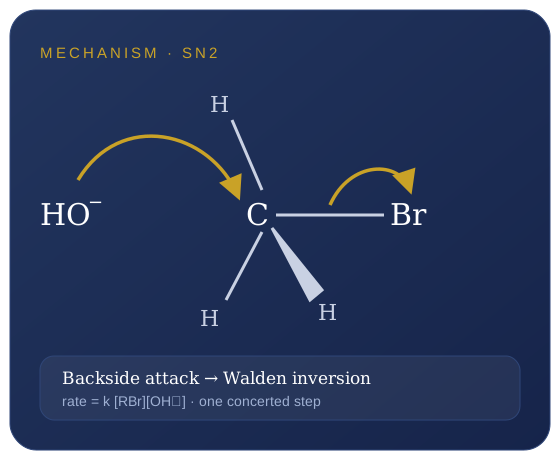
SN2 has the nucleophile in the rate-determining step (rate = k[RX][Nu⁻]), so a strong, negatively charged nucleophile pushes towards SN2. SN1's rate depends only on [RX], so weak, neutral nucleophiles such as H₂O or ROH are typical.
3. Look at the solvent
Polar protic solvents stabilise both the carbocation and the leaving anion by hydrogen bonding — they favour SN1. Polar aprotic solvents (DMSO, DMF, acetone) leave the nucleophile 'naked' and reactive — they favour SN2.
4. Check the stereochemistry the question expects
SN2 gives inversion (Walden inversion) because the nucleophile attacks from the back. SN1 passes through a planar carbocation and gives racemisation, often with slight excess inversion.
Practise this four-step check on every substitution question for a week, and it becomes automatic.